On many architectural and commercial projects, the lumber supplier enters the conversation relatively late. By that point, the architect has developed the design, selected a wood species, established dimensions and profiles, defined appearance requirements, and perhaps even sent the project out for pricing. Only then does someone begin asking whether the specified material is readily available in the form the project requires.
Sometimes everything works exactly as planned, but other times that first conversation with the lumber supplier reveals problems that could have been addressed much more easily months earlier. The specified species may be difficult to obtain in the required dimensions, unusually long or wide clear boards may be needed, or a particular profile may create unnecessary waste. Lead times might not align with the construction schedule, while a relatively minor change in dimensions could potentially improve lumber yield without materially changing the design.
By the time these issues are discovered, making changes may require approvals, redesign, substitution requests, new pricing, or compromises that nobody originally intended. For projects where wood is an important architectural or performance material, involving an experienced lumber supplier before the specification is finalized can help ensure that an attractive design is also practical to source, fabricate, budget, and build.

A Wood Specification Is Also a Supply Specification
Architects naturally approach wood from the perspective of the finished project, considering appearance, performance, dimensions, profiles, durability, and how the material contributes to the overall design. A lumber supplier sees those same requirements from another direction, considering where the material comes from, which dimensions are realistically available, how the species typically arrives from the sawmill, and which grades are commercially obtainable.
There are other practical considerations as well. A supplier may need to determine how much lumber must be sorted to satisfy a particular specification, how the wood will be dried, and what will happen when rough boards are milled into the required finished dimensions. These aren’t separate concerns from the architectural specification; they are part of what determines whether that specification can be executed efficiently.
A requirement that looks perfectly reasonable on a drawing can become expensive or difficult when it encounters the realities of a natural material. Getting the supplier involved early allows those realities to help inform the specification instead of disrupting the project later.
Wood Does Not Come in Unlimited Dimensions
Board size provides one of the simplest examples. A design may require a particular width because it creates the desired visual proportion, but increasing that width even slightly can sometimes move the requirement from commonly available material into something considerably more difficult to source. Length can create similar challenges, particularly when a project requires boards that are simultaneously long, wide, and clear.
Trees ultimately determine what can be sawn from them, and no purchasing department can manufacture additional width or length after the log has been cut. An experienced supplier can review proposed dimensions and identify situations where the specification may be placing unnecessary pressure on the available lumber supply.
In some cases, a relatively small adjustment can create a significant procurement advantage without meaningfully changing the appearance or performance of the finished project. Those are precisely the kinds of opportunities worth identifying before the drawings and specifications become difficult to change.

Ipe Provides an Excellent Example
Ipe is frequently specified for premium decks, boardwalks, docks, rooftop spaces, exterior stairs, benches, and other demanding outdoor applications. Its density, hardness, durability, and appearance make it attractive for projects where long-term exterior performance is important, but specifying “Ipe decking” still leaves many practical questions unanswered.
The supplier needs to understand the required board dimensions and lengths, the desired profile, whether surfaces will be smooth or textured, and whether standard boards or custom milling will be necessary. The fastening system may also affect the material requirements, particularly if hidden fasteners require pregrooved boards. A larger architectural project may also require matching material for stairs, benches, fascia, railings, or other components beyond the primary deck surface.
These details become particularly important on commercial projects involving thousands of square feet of decking. The earlier the complete material package is understood, the more opportunity there is to coordinate available lumber, fabrication, installation requirements, and design intent.
The Highest Grade Is Not Automatically the Best Specification
Another common assumption is that increasingly restrictive material requirements automatically improve the project. In practice, every additional restriction can reduce the amount of lumber capable of satisfying the specification. Requiring exceptionally clear boards, narrow color variation, unusual dimensions, specific grain orientation, and long lengths simultaneously can dramatically reduce the available pool of material.
There are certainly projects where those requirements are justified, but each one should exist for a reason. If a prominent architectural element genuinely requires long, clear pieces, that information is important to the supplier. If those same long boards will immediately be cut into short components, however, the requirement may be increasing material cost and reducing availability without providing any benefit to the finished project.
An experienced lumber supplier can help distinguish characteristics that are essential to the design from those that simply make the specification more restrictive. The objective is not to lower standards, but to make sure the standards being imposed actually contribute to the desired result.

Early Supplier Involvement Creates Opportunities for Value Engineering
Value engineering is sometimes misunderstood as the process of finding a cheaper substitute after a project has exceeded its budget. When done properly, it can begin much earlier and involve making better use of the material rather than simply replacing it with something less expensive.
With lumber, value engineering might involve adjusting dimensions, reconsidering grade requirements, selecting a different cut, changing how components are fabricated, identifying an appropriate alternative species, or determining where premium material provides the greatest benefit. A project requiring wide finished components, for example, might initially call for exceptionally wide solid boards. Depending on the application, another fabrication approach could potentially achieve the same visual objective using more readily available material.
The same principle applies to species selection. If Ipe was chosen because a project requires exceptional exterior durability, any proposed alternative should be evaluated against that performance requirement rather than selected merely because it resembles Ipe or carries a lower price. When the supplier understands why a material or characteristic was specified, meaningful value-engineering options become much easier to identify.
Availability Should Be Discussed Before It Becomes an Emergency
Wood supply is not static. Species availability can fluctuate, certain dimensions may become scarce, import schedules change, tariffs can significantly affect price, and individual sawmills produce different mixes of lumber depending on the logs being processed. These realities can be especially important with imported tropical hardwoods such as Ipe.
Waiting until a project is approaching installation before confirming availability leaves relatively little room to solve a supply problem. Early supplier involvement allows availability to become part of project planning instead. The specified material may be readily obtainable and require no changes at all, but an unusual dimension could need additional lead time, material might need to be reserved earlier than expected, or an alternative could deserve consideration while changing the specification is still relatively straightforward.
None of these issues necessarily represents a problem when identified early. They become problems when they are discovered after the construction schedule has already begun dictating the available options.

Moisture Content & Drying Need to Match the Application
A complete lumber specification should also consider the condition of the wood rather than focusing only on species and dimensions. Wood is hygroscopic, meaning that it exchanges moisture with the surrounding environment, and changes in moisture content can result in dimensional movement.
Appropriate drying and moisture expectations therefore depend in part on what the lumber will become and where it will ultimately be used. Interior architectural millwork has different requirements from exterior decking, just as furniture components have different expectations from heavy exterior timbers.
An experienced lumber supplier understands how different species are dried and how the intended application affects material preparation. That knowledge becomes particularly valuable when a project moves beyond standard products into custom architectural components where dimensional stability and fabrication tolerances may be especially important.
Fabrication Can Influence What Lumber Should Be Purchased
A finished architectural component and the rough lumber used to manufacture it are very different things. Before installation, material may need to be surfaced, ripped, resawn, moulded, sanded, textured, grooved, or finished, and each of those operations can influence what starting material makes the most sense.
This is one area where working with a supplier that understands both lumber and millwork can be particularly useful. J. Gibson McIlvain maintains substantial hardwood inventories while also operating millwork capabilities that can turn rough lumber into finished profiles and components. This allows the material conversation to extend beyond simply determining which boards should be purchased.
Instead, the project team can work backward from the finished component and consider which combination of lumber dimensions, material selection, and processing will produce it efficiently. That approach can reveal opportunities to improve yield, simplify fabrication, or avoid purchasing lumber characteristics that will disappear during machining anyway.

Fastening & Installation Should Not Be Separated from Material Selection
Exterior decking offers another example of how material decisions interact. Ipe is exceptionally dense, which contributes to many of the characteristics for which it is valued, but that density also affects machining and fastening. A specification that identifies the decking species and dimensions while leaving installation details unresolved may therefore be incomplete.
The project team should know whether fasteners will be visible or concealed, whether the selected system requires grooved boards, which board profiles are compatible with the installation method, and how cut ends will be handled. Spacing, drainage, ventilation, and the conditions surrounding the installed decking also need to be considered as part of the overall system.
The lumber supplier does not replace the architect, engineer, contractor, or fastening-system manufacturer, and each party retains a different area of responsibility. Bringing those considerations together before material is ordered, however, can reveal conflicts while they are still relatively inexpensive to correct.
Substitutions Are Easier When the Original Design Intent Is Clear
Occasionally, a specified wood no longer makes sense by the time procurement begins. Pricing may have changed, availability may be limited, required dimensions might be difficult to obtain, or another material may have become a more practical option. This is when projects often begin considering substitutions.
A specification containing little more than a species name provides limited guidance for evaluating those alternatives. If Ipe was originally selected, for example, it is important to understand whether the primary considerations were durability, density, appearance, maintenance expectations, available decking profiles, or some combination of those characteristics.
Without understanding the original design intent, a proposed substitute can easily solve one problem while introducing another. Early collaboration helps establish which characteristics are essential and where flexibility exists, giving the project team a much stronger framework for evaluating alternatives if a substitution eventually becomes necessary.

Early Conversations Can Reduce Waste
Better specifications can also improve material yield. A finished component may require a particular width, for example, but depending on the rough sizes available, changing that finished dimension by a relatively small amount could allow boards to be processed considerably more efficiently.
Across a single board, the difference may appear insignificant. Across thousands of board feet, however, even modest improvements in yield can represent a meaningful amount of material and money. Similar opportunities can arise with length requirements, cut lists, moulding blanks, and other components.
A lumber supplier who understands both available inventory and the finished requirements may be able to identify opportunities that aren’t obvious from an architectural drawing alone. Improving yield can help control the project budget while also making better use of the natural resource already harvested.
The Best Time to Solve a Lumber Problem Is Before It Becomes One
Once bids have been received and construction has begun, flexibility becomes more expensive. A species change may require approval, a dimensional change may affect drawings, and a profile adjustment can interact with adjacent materials. Longer lead times may affect scheduling, while a substitution could require new samples, mockups, or additional review.
These problems are not necessarily impossible to solve later in the project, but they are generally much easier to address during design. Bringing a knowledgeable lumber supplier into the conversation early provides another perspective focused specifically on material realities such as sourcing, dimensions, grade, yield, drying, machining, availability, and logistics.
The architect remains responsible for the design, while the supplier can help determine whether the wood required to execute that design is realistically available in the form the project needs. That relationship works best when there is still enough flexibility to act on the information being shared.
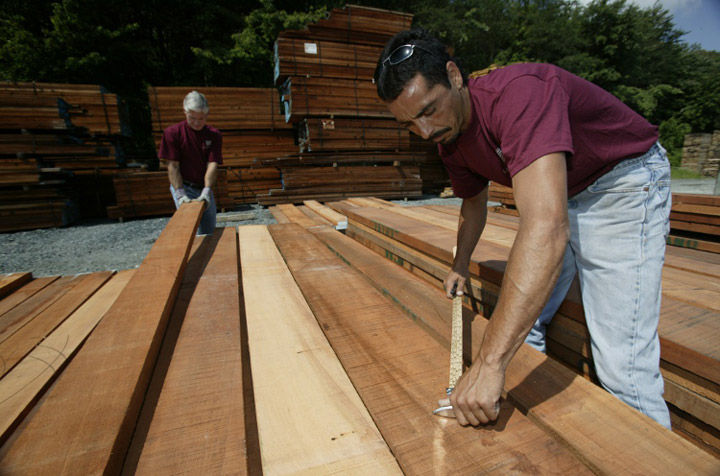
A Lumber Supplier Should Be More Than a Place to Request a Price
For relatively straightforward projects, purchasing lumber can sometimes be transactional. Complex architectural, commercial, manufacturing, and large-scale exterior projects are different because the consequences of material decisions extend well beyond the initial board-foot price.
J. Gibson McIlvain has supplied domestic and imported hardwoods since 1798 and today combines lumber sourcing and inventory with drying, milling, custom architectural millwork, finishing, and nationwide delivery. That broader perspective makes it possible to begin the conversation with the requirements of the project rather than simply asking what a particular species costs.
Whether an architect is considering Ipe for a commercial deck, Sapele for custom doors, Genuine Mahogany for millwork, White Oak for an interior package, or another hardwood for a specialized application, there can be substantial value in discussing the specification while decisions can still be adjusted. A lumber supplier doesn’t need to design the project, but an experienced supplier can explain how the proposed design intersects with the realities of sourcing and working with wood.
Once a specification is finalized, every requirement on the page becomes something that somebody eventually has to source, manufacture, deliver, and install. Finding out whether those requirements make practical and economic sense is much easier while the specification is still being developed.
Editor Note: A; C.