
Wood is one of the most beautiful and versatile building materials available. It brings warmth, character, durability, and natural variation that few manufactured materials can truly replicate. But wood also has a characteristic that every architect, builder, contractor, and homeowner must understand: wood moves.
Even after a tree has been harvested, milled, dried, and installed, the wood continues to respond to its environment. Temperature and humidity changes cause wood to expand and contract over time, and this natural movement can significantly affect the performance and appearance of a finished project.
Understanding wood movement is especially important when working with dense hardwoods like Ipe, which are often used in demanding exterior applications such as decking, siding, and architectural features. While Ipe is known for its exceptional durability and stability, it is still a natural material – and all natural wood moves to some degree.
With generations of experience supplying premium hardwoods, J. Gibson McIlvain Co. understands that successful projects are not achieved by fighting wood movement, but by planning for it properly from the start.

Why Wood Moves in the First Place
Wood is hygroscopic, which means it naturally absorbs and releases moisture depending on the surrounding environment.
When humidity levels rise, wood absorbs moisture from the air and expands. When conditions become drier, wood releases moisture and contracts. This process continues throughout the life of the material.
Even kiln-dried lumber is not “finished” moving forever. Drying simply reduces the wood’s moisture content to a more usable level before installation.
Once installed, the wood continually seeks equilibrium with its environment.
This movement occurs across all wood species, although the degree of movement varies depending on:
- Species characteristics
- Grain orientation
- Moisture content
- Environmental exposure
- Installation conditions
Understanding these variables is the foundation of successful wood design and installation.

Wood Movement Is Natural – Not a Defect
One of the most important things to understand is that wood movement is normal.
Minor expansion and contraction are not signs of poor-quality lumber. In fact, even the highest-grade hardwoods will move as conditions change.
Problems usually occur not because wood moves, but because projects fail to account for that movement during design, specification, or installation.
When movement is ignored, issues can develop such as:
- Gaps between decking boards
- Warped or cupped lumber
- Cracked panels
- Split joints
- Buckling surfaces
- Stressed fasteners
In many cases, these problems are preventable with proper planning.

Exterior Projects Face the Greatest Challenges
Outdoor environments create some of the most demanding conditions for wood movement.
Exterior decking, siding, pergolas, and cladding systems are constantly exposed to:
- Rain and moisture
- Sun and heat
- Seasonal humidity changes
- Freeze-thaw cycles
- Airflow variations
These shifting conditions create continual expansion and contraction cycles throughout the year.
This is one reason why species selection matters so much. Dense tropical hardwoods like Ipe are highly valued because they offer greater dimensional stability than many softer woods. Ipe’s density and natural resistance to moisture-related deterioration help reduce excessive movement and improve long-term performance.
However, even highly stable hardwoods still require proper spacing, fastening, acclimation, and installation planning.
No wood species is completely movement-free.

Moisture Content Plays a Major Role
One of the biggest factors affecting wood movement is moisture content at the time of installation.
If lumber is installed while too wet, it may shrink significantly as it dries. If installed too dry, it may expand once exposed to higher humidity conditions.
This is why moisture management is so important throughout the supply chain – from milling and drying to storage and delivery.
Before installation, lumber should ideally reach a moisture content that is reasonably close to the environment where it will ultimately be used.
For exterior hardwood decking projects, this often means allowing lumber to acclimate on-site before installation begins.
Acclimation gives the wood time to adjust gradually to local environmental conditions, helping reduce dramatic movement after installation.
Skipping this step can lead to avoidable issues later.
Proper Spacing Is Essential
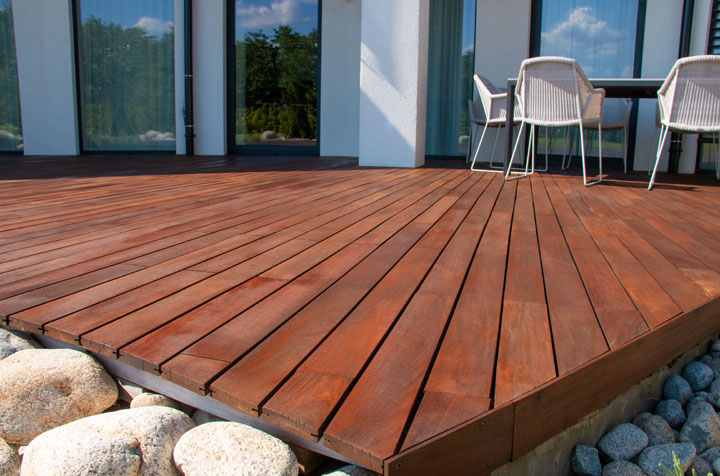
One of the most visible examples of wood movement occurs in decking installations.
Deck boards need room to expand and contract as environmental conditions change. If boards are installed too tightly, they may press against one another during expansion, potentially causing buckling or stress on fasteners.
If spaced too widely, excessive gaps may develop during drier conditions.
The ideal spacing depends on several factors, including:
- The species being used
- Moisture content at installation
- Local climate conditions
- Board dimensions
With hardwoods like Ipe, installers often need to account for both the density of the material and the expected environmental exposure.
This is where experience matters. Understanding how a species behaves over time allows installers to make more accurate spacing decisions from the beginning.

Grain Orientation Also Influences Movement
Not all wood movement occurs equally.
Wood tends to move more across its width than along its length. Additionally, the orientation of the grain affects how the material behaves over time.
For example:
- Flat-sawn lumber typically experiences greater width movement
- Quarter-sawn lumber tends to offer greater stability
This is one reason quarter-sawn material is often preferred for high-end millwork, doors, windows, and architectural applications where dimensional stability is especially important.
In some projects, specifying the proper cut of lumber can significantly improve long-term performance.

Fastening Systems Must Accommodate Movement
Wood movement also affects fastening systems.
As wood expands and contracts, stress is placed on screws, clips, nails, adhesives, and joints. Improper fastening can lead to:
- Loosened fasteners
- Splitting
- Surface cracking
- Distorted boards
This is particularly important with dense hardwoods like Ipe, which require specialized installation techniques due to their hardness.
Best practices often include:
- Pre-drilling fastener holes
- Using high-quality stainless steel fasteners
- Allowing appropriate spacing around connections
- Choosing fastening systems designed for hardwood decking
The goal is not to prevent movement entirely, but to allow the wood to move naturally without damaging the surrounding structure.

Interior Wood Applications Move Too
While exterior environments create more dramatic conditions, interior wood applications are not immune to movement.
Interior hardwood flooring, cabinetry, paneling, and trim can all respond to seasonal humidity shifts within a home.
In colder climates, indoor air often becomes very dry during winter months due to heating systems. During summer, humidity levels may rise significantly.
Over time, these fluctuations can affect:
- Flooring gaps
- Cabinet joints
- Panel alignment
- Door operation
Climate control systems help moderate these changes, but proper design and installation remain essential for minimizing visible movement.

Designing with Wood Movement in Mind
The best wood projects are designed around the realities of the material itself.
Rather than expecting wood to behave like plastic or metal, experienced architects and builders work with its natural characteristics.
This may involve:
- Allowing expansion gaps
- Using floating installation methods
- Selecting stable species for demanding applications
- Accounting for seasonal climate changes
- Choosing proper grain orientations
- Specifying correct fastening systems
Good design anticipates movement before it becomes a problem.
In many ways, understanding wood movement is part of understanding wood craftsmanship itself.

Why Experience Matters
Wood movement is influenced by countless variables, and real-world conditions rarely behave exactly the same from one project to the next.
This is why experienced hardwood suppliers play such an important role.
Companies like J. Gibson McIlvain Co. understand how species behave across different climates, applications, and installation conditions. From moisture management and milling to delivery and technical guidance, that expertise helps clients avoid costly mistakes and achieve better long-term results.
When working with premium hardwoods like Ipe, that level of insight becomes especially valuable.

Planning for Movement Leads to Better Projects
Wood movement is not something to fear – it is simply something to respect and plan for.
When projects account for moisture content, spacing, acclimation, grain orientation, and fastening methods, wood performs remarkably well over time. In fact, many of the world’s most beautiful and durable structures have relied on these principles for centuries.
The key is understanding that wood is a natural material with natural behavior.
By designing and building with those realities in mind, architects, builders, and homeowners can create projects that not only look beautiful on day one, but continue performing successfully for years to come.
And when properly planned and installed, premium hardwoods like Ipe remain among the most durable, stable, and rewarding materials available for both exterior and interior applications.
Editor Note: A; C.


