What makes Brazilian Teak a viable alternative to Ipe?
Ipe has earned its reputation as one of the premier woods for exterior decking, but it isn’t the only South American hardwood capable of performing in demanding outdoor applications. Cumaru, sometimes called Brazilian Teak, shares several of the characteristics that make Ipe attractive for decks, boardwalks, siding, and other exterior projects while offering its own appearance and performance characteristics.
At J. Gibson McIlvain, Cumaru has become an important part of our tropical hardwood decking program and is frequently considered by customers looking for an alternative to Ipe. It is exceptionally hard and dense, naturally resistant to decay, and available in the dimensions commonly required for residential and commercial decking. It can also offer a meaningful cost advantage over Ipe depending on current market conditions and availability.
That does not make Cumaru an inexpensive version of Ipe, nor should the two species be treated as interchangeable. Understanding where they are similar—and where Cumaru requires somewhat different consideration—is the better way to decide whether it makes sense for a particular project.
What Is Cumaru?
Cumaru (Dipteryx odorata) is a tropical hardwood native to South America and is commonly marketed in the United States as Brazilian Teak. Despite that trade name, Cumaru is not botanically related to genuine Teak. The name reflects the wood’s use as a durable tropical hardwood rather than a botanical relationship between the species.
Cumaru is extremely dense and hard, with excellent natural resistance to decay. Those properties make it particularly well suited to exterior applications where the wood will face rain, humidity, sunlight, temperature changes, and regular foot traffic.
Decking is one of its most familiar uses, but Cumaru is not limited to horizontal surfaces. J. Gibson McIlvain also supplies it for siding, soffits, architectural millwork, railings, rafter tails, and other exterior applications. Larger timber sizes can be sourced for certain projects as well.
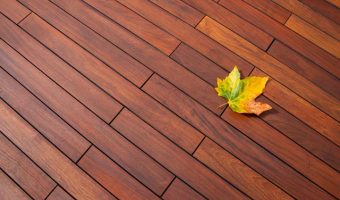
Like Ipe, Cumaru is a natural product with variation from board to board. Its color can range from yellowish and golden brown through reddish brown and deeper brown tones, often with considerable variation within the same order. Cumaru also tends to have a more pronounced or coarser grain appearance than Ipe, which can make it visually distinctive rather than simply an Ipe look-alike.

How Does Cumaru Compare with Ipe?
The comparison begins with density and hardness. Cumaru is an exceptionally hard wood and belongs in the same general class of dense tropical hardwoods as Ipe. That gives it excellent resistance to wear and makes it suitable for high-traffic exterior surfaces.
Its natural durability is another reason it works well as decking. A properly designed and installed Cumaru deck can provide decades of service, which makes it a very different proposition from choosing a lower-cost material primarily because it is inexpensive. Customers considering Cumaru are still looking at a premium tropical hardwood intended for long-term exterior use.
There are differences, however, and dimensional stability is one of the most important. Ipe is particularly well known for its stability. Cumaru tends to move more as its moisture content changes, which makes drying, acclimation, board thickness, ventilation, and installation practices especially important.
Appearance differs as well. Ipe typically offers brown and olive-brown tones with its own considerable natural variation, while Cumaru can present warmer golden, reddish, and brown colors. Some customers specifically prefer the more active grain and broader color variation of Cumaru. Others want the appearance associated with Ipe. Neither preference makes one species inherently better; it simply means samples and actual boards should be considered as part of the selection process.
Why Board Thickness Matters with Cumaru
One of the lessons J. Gibson McIlvain has learned from working with Cumaru is that its excellent strength and hardness do not eliminate the need to account for wood movement.
For standard decking, we favor the thicker Cumaru profiles that provide greater stability rather than trying to reduce material cost by making the board unnecessarily thin. The appropriate thickness will ultimately depend on the application, framing, span requirements, and project specification, but Cumaru’s movement characteristics should be considered when making that decision.
This is a good example of why comparing tropical hardwoods solely by price can be misleading. Saving money by purchasing a thinner or otherwise less appropriate product provides little value if doing so makes the installation more susceptible to movement later.
Proper drying is equally important. Exterior Cumaru should be dried for the conditions in which it will be used and then allowed to acclimate appropriately before installation. As with Ipe, the objective is not to eliminate all movement—something no natural wood can promise—but to begin with properly prepared material and design the installation to accommodate the normal changes that occur as outdoor conditions vary.
Cumaru Requires the Right Tools & Installation Practices
Cumaru’s extreme density is an advantage once the deck is in service, but installers need to account for that density while working with it. This is not a species that should be approached like pressure-treated pine.
Sharp, appropriate cutting tools are important, and pre-drilling is generally required for face-fastened installations. Hidden-fastener systems can also be used with properly grooved Cumaru decking when the board profile and fastening system are compatible. Because the grain can be interlocked, attention to machining direction and tool condition helps produce a cleaner surface.
Installers should also plan for proper spacing, airflow beneath the deck, drainage, and sealing of freshly cut ends. These practices matter with tropical hardwood decking generally, but Cumaru’s somewhat greater tendency toward movement makes good moisture management particularly important.
A contractor who has previously installed Ipe will recognize many of the same requirements when working with Cumaru. The mistake would be assuming that because the two woods occupy a similar category, every detail of their behavior is identical.
Natural Color Variation Is Part of Cumaru’s Appearance
One reason homeowners and designers choose real wood is that no two boards are exactly alike, and Cumaru makes that especially apparent. An order can contain golden-brown boards alongside considerably redder or darker material, with grain differences adding another layer of variation.
That natural range can produce an attractive deck, but expectations should be established before installation. If boards with noticeably different coloration are concentrated in individual areas, the variation may appear accidental. Laying out material before fastening allows installers to distribute colors and grain patterns throughout the deck more intentionally.
Finishing can influence the appearance but should not be expected to make every board identical. Penetrating finishes formulated for dense tropical hardwoods can enrich Cumaru’s natural color and help maintain a freshly finished appearance, but the underlying variation in the wood will remain visible.
Cumaru can also be allowed to weather naturally. As with Ipe and other exterior hardwoods, exposure to ultraviolet light will gradually move the surface toward a silver-gray appearance if the original coloration is not periodically maintained. The decision to preserve the brown and reddish tones or allow the deck to weather is largely aesthetic rather than an indication of whether the wood remains durable.

When Does Cumaru Make Sense as an Ipe Alternative?
Cumaru deserves serious consideration when the project calls for a dense, naturally durable tropical hardwood but does not specifically require Ipe. Depending on current lumber markets, it can provide a lower material cost while retaining many of the performance characteristics that led the architect, contractor, or homeowner toward tropical hardwood decking in the first place.
The decision becomes more nuanced when a project has very specific appearance requirements or when dimensional stability is the overriding concern. Ipe remains exceptional in those areas, and changing species merely to reduce the purchase price may not make sense if the substitution changes characteristics that are important to the design.
Cumaru can be especially attractive when the owner likes its warmer coloration and more active grain rather than viewing those characteristics as compromises. In that situation, the project isn’t simply accepting Cumaru because Ipe costs more. Cumaru may actually be the preferred material.
Availability also matters. Lumber markets change, and the relative price and availability of Ipe and Cumaru can change with them. Evaluating the species against the actual requirements and current supply situation is more useful than relying on a fixed rule about how much one should cost relative to the other.
Responsible Sourcing Matters with Any Tropical Hardwood
Species selection is only one part of purchasing tropical lumber. Understanding where the material came from and whether it moved through a legal and responsible supply chain is equally important.
J. Gibson McIlvain is a direct importer of tropical hardwoods and works with established mills and suppliers in South America and other lumber-producing regions. As Importer of Record, we are directly involved in the documentation and due diligence associated with the exotic hardwoods we import rather than purchasing anonymous material after it has already passed through multiple layers of the domestic market.
That oversight accompanies the quality control process applied to the material itself. Species, grade, dimensions, drying, milling, and overall suitability for the customer’s application all matter when preparing an order.
For Cumaru in particular, proper drying and appropriate dimensions are important enough that the quality of the supply chain cannot be separated from the performance of the finished deck.
Cumaru Is More Than a Second Choice
Calling Cumaru an “alternative to Ipe” is useful because Ipe provides a familiar reference point for customers shopping for tropical decking. It can also unintentionally make Cumaru sound like a compromise selected only when the preferred material is too expensive.
That understates what Cumaru offers.
It is an exceptionally dense, hard, naturally durable South American hardwood with a distinctive range of colors and grain patterns. Its stability requires somewhat more consideration than Ipe, particularly when drying and installing the material, but those differences are well understood and manageable when Cumaru is properly prepared and installed.
For some projects, Ipe will remain the better choice. For others, Cumaru can provide the durability, appearance, dimensions, and service life the project requires while offering better economics. In still others, the customer may simply prefer the appearance of Cumaru.
The important part is making that comparison according to the project rather than assuming that one tropical hardwood is automatically right for every application. J. Gibson McIlvain’s tropical hardwood specialists can help evaluate species, dimensions, availability, and application requirements when deciding whether Cumaru or another decking species is the appropriate choice.
Ipe Alternatives
No wood species duplicates every characteristic of Ipe. Different tropical hardwoods do, however, offer combinations of durability, hardness, appearance, stability, availability, and cost that can make them viable alternatives depending on the project and environment. Learn more about the Ipe alternatives below: